The passé composé : when to use it and how to form it
Difficulty:A2
-
February 10, 2026
2/10/2026
The passé composé is used to talk about a completed action in the past. It’s a very practical tense to describe what you did (yesterday, last week, during your holidays, etc.).
When to use the passé composé
A single, punctual action in the past
Use it for an action that is short, precise, and finished.
Hier, j’ai mangé une pizza.
Ce matin, il a appelé sa mère.
An action with a limited duration (start + end)
The action lasts for a certain time, but it is over: it has a beginning and an end.
J’ai attendu le bus 5 minutes.
Nous avons travaillé deux heures.
A sequence of actions
It’s also very common to use the passé composé to tell a story with actions that follow one another.
Il s’est levé, il a pris une douche, puis il a bu un café et il est parti au travail.
How to build the passé composé

The passé composé has two parts:
1) an auxiliary in the present tense: avoir or être
2) the past participle of the verb
Auxiliary in the present + past participle
J’ai fait un gâteau.
Il est allé à Paris.
Simple examples (avoir / être)
With avoir: j’ai + past participle.
With être: je suis / il est + past participle.
J’ai mangé, j’ai dormi, nous avons travaillé.
Je suis arrivé, elle est partie, ils sont allés.
Choosing between avoir and être
General rule: most verbs use avoir
Most verbs use avoir in the passé composé.
Nous avons voyagé.
Tu as dormi.
Elle a répondu.
Verbs with être: the “être mountain”
Only a small number of verbs use être. Very often, they are movement verbs (going from one place to another).
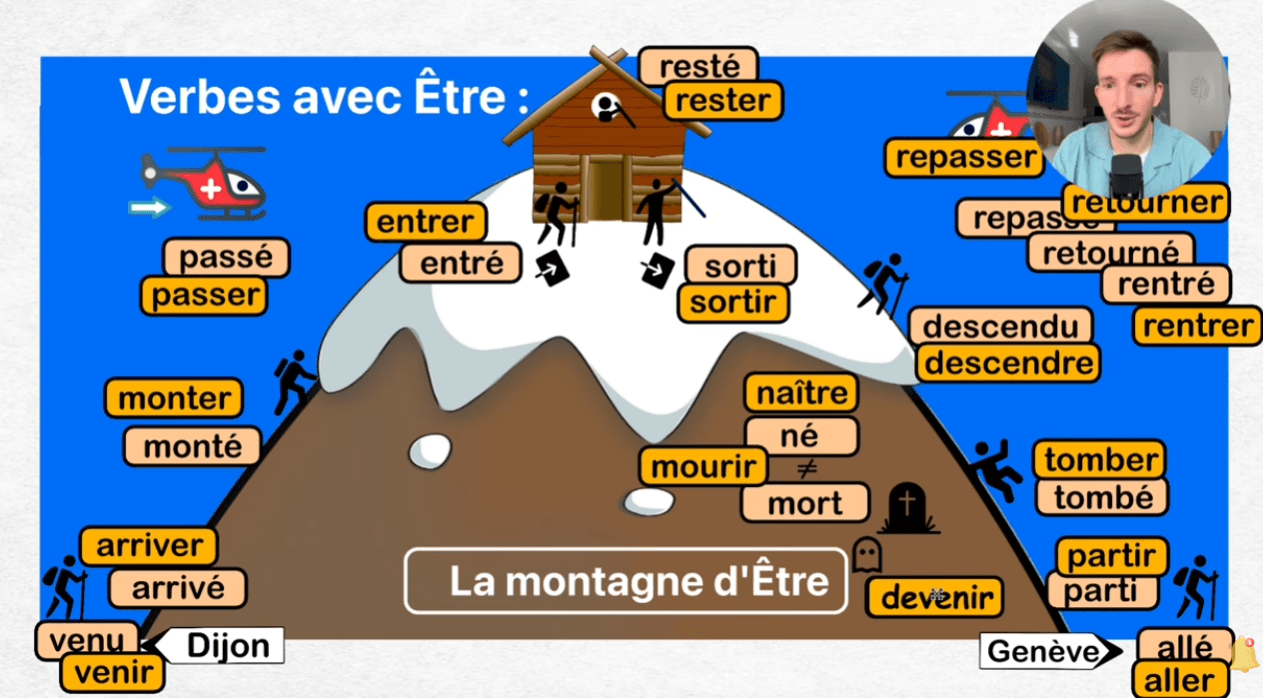
Je suis : venu, arrivé, monté, passé, entré, sorti, resté, retourné, rentré, descendu, tombé, parti, allé, né, mort, devenu.
Je suis arrivé.
Il est parti.
Elle est devenue infirmière.
Reflexive verbs: se + être
Verbs with se (reflexive verbs) use être.
Structure: pronoun + être + past participle
je me suis… / tu te es… / il-elle se est… / nous nous sommes… / vous vous êtes… / ils-elles se sont…
Hier, je me suis levé tôt.
Elle s’est préparée rapidement.
Note: if the verb starts with a vowel, it contracts: se est → s’est.
Forming the past participle
The past participle is the “past form” of the verb. There are simple patterns, but also irregular forms you need to memorize.
Verbs in -er: -é
This is the easiest pattern: -er → -é.
manger → mangé : j’ai mangé
travailler → travaillé : nous avons travaillé
visiter → visité : elles ont visité
laver → lavé : j’ai lavé
Verbs in -ir: -i or -u (common cases)
Many -ir verbs form the past participle with -i, but some are in -u.
finir → fini : tu as fini
choisir → choisi : j’ai choisi
partir → parti : je suis parti
courir → couru : il a couru
venir → venu : je suis venu
Other endings and common irregular forms (-is, -it, -u)
You will also find past participles ending in -is and -it, and many irregular ones ending in -u.
mettre → mis : j’ai mis
prendre → pris : j’ai pris
dire → dit : il a dit
écrire → écrit : j’ai écrit
boire → bu : il a bu
voir → vu : j’ai vu
Mini-list to memorize (very useful at A2)
Very frequent : être → été / avoir → eu / faire → fait / prendre → pris / mettre → mis / voir → vu / boire → bu / pouvoir → pu / devoir → dû / vouloir → voulu / venir → venu / partir → parti / aller → allé / arriver → arrivé
Agreement with être (A2 reminder)
With être, the past participle agrees with the subject:
feminine: +e
plural: +s
Il est arrivé.
Elle est arrivée.
Ils sont arrivés.
Elles sont arrivées.
Lucie s’est levée.
Exercises
Loading...
Loading...
Conclusion
The passé composé is used for completed actions in the past: a specific moment, a finished duration, or a sequence of actions. Focus on the structure: avoir/être in the present + past participle, then gradually memorize the most frequent past participles.
Want to practice with guided examples and improve faster? Check out our FIDE e-learning course on the site.
Contact FIDE Preparation