FIDE A2: How to Describe a Picture in the Oral Exam (Task 1)
Difficulty:A2
-
February 17, 2026
2/17/2026
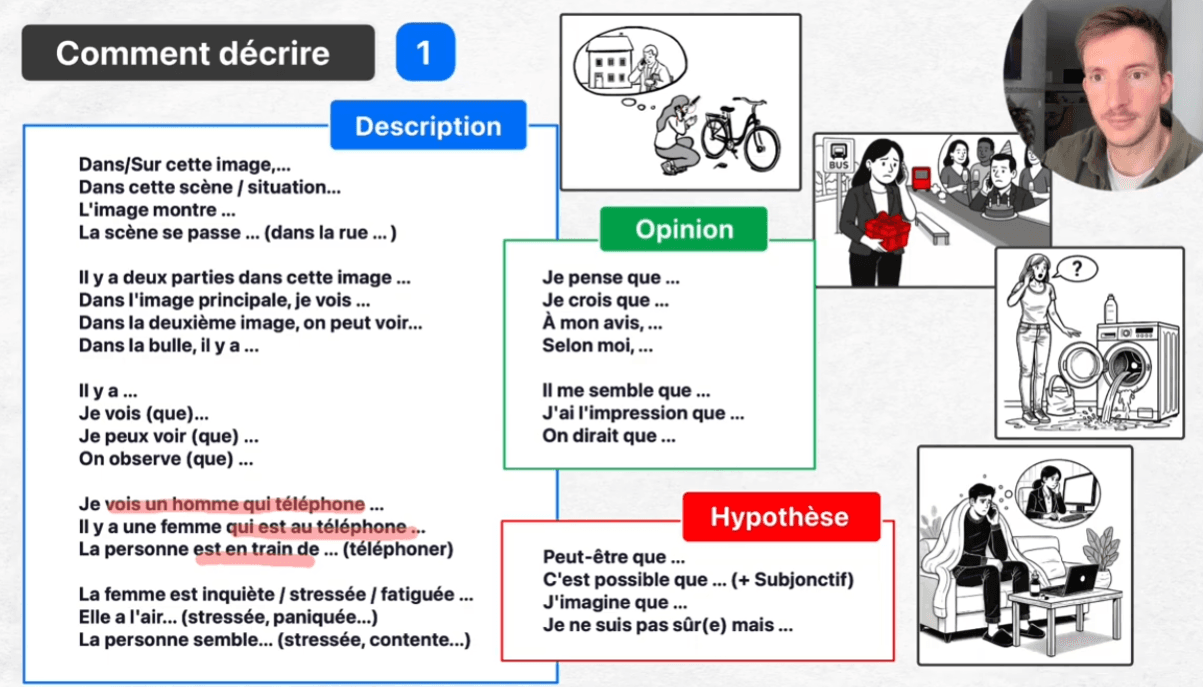
In the FIDE A2 oral exam, task 1 is a picture description. The goal is not to tell a complex story, but to show that you can describe people, actions, and a situation with simple and correct French.
Understanding FIDE A2 task 1
You usually have two parts in the prompt:
1) the main picture (the scene)
2) a second picture (often a bubble) that adds extra information
The examiner wants to see if you can: say what you see, locate the scene, describe an action, express an emotion, give an opinion, and (if you want) make one or two hypotheses.
Ready-made starter phrases
To begin, use simple reusable sentences (in French):
Le saviez-vous ?
say un homme / une femme (more natural) rather than “un monsieur / une madame”.
Locating things in the picture
If you want to be more precise, you can locate elements:
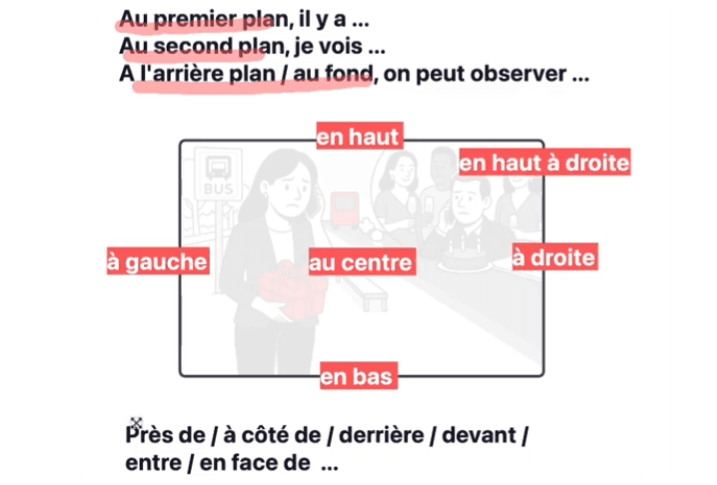
À côté de la femme, il y a un vélo. Derrière elle, on voit un arrêt de bus.
Describing people and actions
Common actions at the exam
être au téléphone : Elle est au téléphone.
être en train de + infinitif : Elle est en train de téléphoner.
Il est en train d’attendre quelqu’un.
Describing a person (simple)
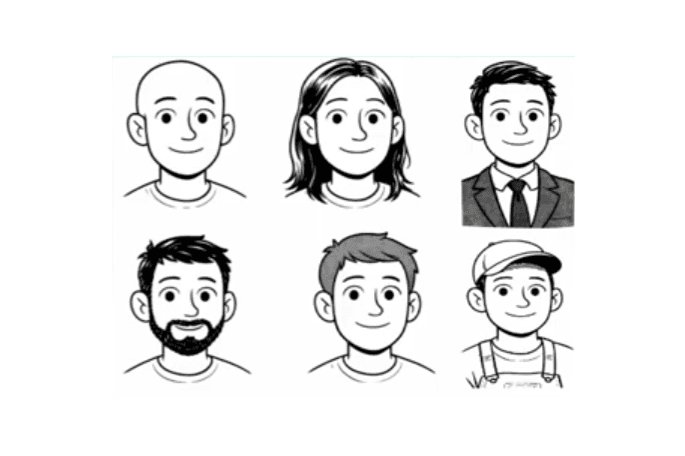
You do not need to describe everything (hair color, etc.). Mention details only when they are useful:
Il est bien habillé. → He is well dressed.
Il porte une chemise / une cravate. → He is wearing a shirt / a tie.
Il porte une casquette. → He is wearing a cap.
Il a une barbe. → He has a beard.
Il est chauve. → He is bald.
Il a des lunettes. → He is wearing glasses.
Expressing emotions (A2 level)
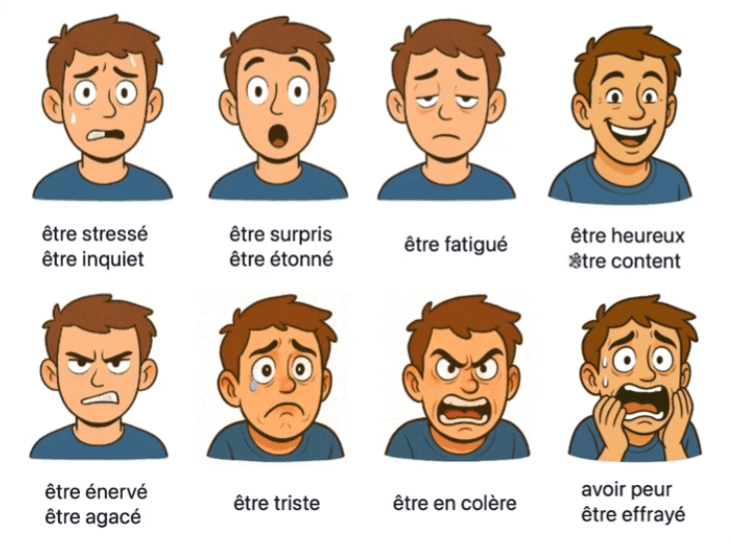
Three very effective structures:
1) être + adjective
Elle est inquiète / stressée.
Il est fatigué.
Elle est triste.
Il est content / heureux.
Il est en colère.
Il a peur / il est effrayé.
Il est surpris / étonné.
2) avoir l’air + adjective
Elle a l’air stressée. Il a l’air fatigué.
3) sembler + adjective
Il semble inquiet. Elle semble triste.
Watch the feminine forms: inquiet → inquiète, content → contente, surpris → surprise.
Giving your opinion (simple, but varied)
Vary your opinion phrases to sound more comfortable:
- Je pense que…
- Je crois que…
- À mon avis…
- Selon moi…
- Il me semble que…
- J’ai l’impression que…
- On dirait que…
Je pense que la femme a un problème avec son vélo. J’ai l’impression qu’elle est en retard. On dirait que le bus est parti.
Making hypotheses (optional, but useful)
If you still have time, add 1–2 simple hypotheses:
- Peut-être que…
- J’imagine que…
- Je ne suis pas sûr(e), mais…
Peut-être qu’elle veut changer l’heure du rendez-vous. J’imagine qu’elle va arriver dans 30 minutes.
Note: “C’est possible que” requires the subjunctive. If you are not sure, stick to peut-être que.
Linking ideas with simple connectors
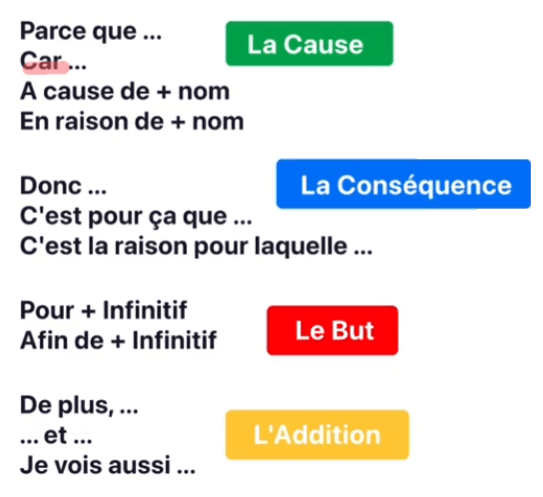
Elle téléphone parce qu’elle est en retard. Elle est en retard à cause d’un problème avec son vélo.
Elle a un problème, donc elle appelle. C’est la raison pour laquelle elle téléphone.
Elle téléphone pour prévenir l’agent immobilier.
Important with “aussi”: say Je vois aussi… (not “Aussi je vois…”).
The 4-step strategy (the “anti-forget” method)
Always follow the same structure:

1) Describe the main picture
2) Describe the second picture (bubble)
3) Explain the situation (the link between both)
4) Add 1–2 hypotheses (if needed)
With this structure, you do not forget anything and you stay clear.
Useful vocabulary that often comes back
un rendez-vous : prendre / changer / annuler un rendez-vous
téléphoner à quelqu’un
informer / prévenir quelqu’un
être en retard
visiter un appartement
un agent immobilier
Conclusion
To succeed in FIDE A2 task 1, keep a simple structure, use ready-made phrases, and add an opinion plus a connector.
Don’t wait any longer, start your preparation for free, benefit from a tailored preparation, and receive all the necessary documents to best prepare for the exam.
Don't wait any longer and give yourself the best chance to pass the FIDE test!
Would you like some practical advice on how to approach the test with maximum confidence? Continue reading

Contact FIDE Preparation